For Better or For Worse? FNME vs GPAR

Over the years, I have provided appraisals for properties owned by individuals going through divorce proceedings and have had the opportunity to be used in several counties as an expert witness. Whenever I am providing an appraisal for marital dissolution purposes, there are a few things I keep in mind. Most important is the possibility that my report might end up being used as part of expert witness testimony in a formal court proceeding. For this reason, it is important to know the correct form to use.

Most appraisers complete their reports on Fannie Mae produced forms as the majority of the work completed is for lending purposes. It is important to understand that these forms were created by and expressly for Fannie Mae purposes. There are pre-printed certifications which clearly indicate the use of and purpose for these forms.

Unfortunately, using Fannie Mae forms for litigation work is a mistake. While an appraiser should be aware of this, I have found in reviewing opposing counsels “expert” appraisal reports that many use the wrong form. Legal authorities have advised and forewarned that the use of the 1004 URAR appraisal form for litigation purposes carries the risk of having that report thrown out and ultimately, that side losing their case.

Per Jody Bruns, CDLP, using the wrong form could be a costly mistake and can jeopardize a case. Check out the full article here:

http://digitaleditions.walsworthprintgroup.com/publication/?i=286075&article_id=2358305&view=articleBrowser

In the future, if you are looking to have an appraisal completed for divorce purposes, be sure that you engage the services of an appraiser who has the experience and knowledge to know that using the correct form can make all the difference in your case.

Neighborhood vs Market Area

One of the foundations that determines the value of a property is the well known mantra- location, location, location. But what does that really mean? Simply put, the value of a property is in direct relation to where it is located- both its neighborhood and the market area it is located within. An appraiser should be able to define the neighborhood along with the market area in order to research and accurately report those factors that affect the value of a property.

What defines a subject’s neighborhood? A neighborhood is a group of complementary land uses, a congruous grouping of inhabitants, buildings or business enterprises. It focuses on four sets of considerations that influence value: social, economic, governmental and environmental factors. Sometimes, a neighborhood is well defined- consider some housing plans and subdivisions or even small towns. In more rural areas, the neighborhood is less easily defined and could encompass an entire municipality.

So then, how is the neighborhood different from the market area? A market area is the geographic or locational delineation of the market for a specific category of real estate. It is an area in which alternative similar properties effectively compete with the subject in the minds of potential purchasers, often referred to as the buyer pool. A market area is often much larger than a neighborhood. A property located in a subdivision could have a market area that includes additional alternative subdivisions that would have a similar appeal based on the location, school district, access to local amenities, median price range, etc.

Within any given market analysis is a term referred to as market segmentation. This is the process by which submarkets within a larger market are defined. Specifically, it is taking a look at the market data and determining segmented portions such as retirement communities, condominiums, investment properties, etc.

One example would be a sub-market for condominiums in Murrysville. Condominiums in this market area make up less than 10% of the overall real estate but there is a well defined buyer pool for these types of properties. In order to analyze the impact of value on a condominium in Murrysville, you would need to first analyze the plan it is located in (the neighborhood), then analyze Murrysville as a whole (the market area) and then further extract that data to analyze other similar condominiums in Murrysville (segmented market area).

As you can see, the location of any given property can be directly influenced by its direct neighborhood, the larger market area and the segment of the market that it is classified as.

In the near future, I’d like to take a very real but hypothetical look at an example property and how knowing both your neighborhood and market area has a direct impact on the data needed to be analyzed and the comparables chosen.

Appraisal Racial Bias (part 3)

I’ve been discussing the topic of real estate appraisals and the allegations of racial bias that has the possibility of creating issues for some homeowners or potential homeowners. There have been a few cases that have had the spotlight shown on them and the scenarios are all relatively similar.

It starts with an appraisal that is completed on a home where the occupant is of a minority race- whether the appraiser meets the occupant in person or there are pictures and other personal contents that elude to the persons race within the home. When the appraisal is completed it is perceived to be “low”. A subsequent appraisal is completed in which the home has now been “whitewashed”. If you haven’t heard of the term, it refers to the process of removing all indications of minority race within the home and even having a white person stand in as the fake homeowner. Some of the current cases out there are real life examples and others are experiments in which the entities conducting these are doing it for the sole purpose of trying to prove that the appraisal process is inevitably biased.

In either case, these are serious allegations.

I’d like to ask a few provoking questions that don’t have easy answers.

Does a value that comes in lower than what someone was expecting or desiring automatically mean the value is wrong?

When a homeowner or occupant is of a minority race, if the appraisal value is lower than what someone feels it should be, does that mean racial bias came into play?

Is it possible that the lower value was accurate and that the higher value was a case of reverse bias?

There is one case in particular that took place for a black couple out of northern California where the homeowners make this statement to CNN- “What that appraisal did is what we were actually asking the appraisers to do, to not consider race, to not consider neighborhoods and or the lines that have been drawn and perpetuated by redlining.” Based on this statement, if an appraiser stays within the neighborhood and the neighborhood happens to be primarily occupied by a minority group, does this indicate racial bias was a factor in completing the appraisal?

In the future, I’d like to discuss more the idea of neighborhoods and market areas. For now, I hope these questions have been thought provoking and at least given some pause to consider different angles.

Appraisal Racial Bias (part 2)

As mentioned in part 1 of this series, Federal Fair Housing Laws states in clear terms that when it comes to real estate, an individual cannot discriminate based on protected factors. These protected classes include race, color, national origin, religion, sex, gender identity, sexual orientation, familial status, or disability.

As of this writing, the current edition of USPAP is even more detailed when it pertains to the profession of appraising and it states “An appraiser must not use or rely on unsupported conclusions relating to characteristics such as race, color, religion, national origin, gender, marital status, familial status, age, receipt of public assistance income, handicap, or an unsupported conclusion that homogeneity of such characteristics is necessary to maximize value.”

USPAP is a document that is continually being revised. This task is accomplished by members of the Appraisal Standards Board which is an independent board of The Appraisal Foundation. They have been arduously addressing the matter of bias and as part of the current revisions being proposed, are conducting a comprehensive look into the Ethics Rule. As part of their process, they even consulted with antidiscrimination experts in July 2022.

Currently, the proposed changes to USPAP is in its 4th exposure and while I am not going to disclose the contents of these proposed revisions, it seems very apparent that the goal of the current board is to make it abundantly clear within USPAP that unethical and illegal discrimination is explicitly prohibited. If you are interested in reading the draft, you can find it on The Appraisal Foundation website of click on this link: https://appraisalfoundation.sharefile.com/share/view/s80c9bc7163694f5a809cb401316d53cf

Even though USPAP has for a long time always required appraisers to be unbiased, I am proud to be included in a profession that has chosen to continue taking this matter seriously and clearly spell out where we stand. The public needs to be assured that our profession has not, does not and will not tolerate unethical and illegal discrimination.

Appraisal Racial Bias.... Pardon our Interruption

Part 2 has been written and was ready to drop today except for the necessity to provide you important information regarding fast approaching upcoming hearings. Earlier this year, the CFPB’s (Consumer Financial Protection Bureau) Fair Lending Director, Patrice Alexander Ficklin, stated that they were going to prioritize resources to focus on the role of racial bias in home appraisals

The CFPB has announced that they will be holding a hearing with the ASC (Appraisal Subcommittee) specifically to discuss this issue. This hearing is open to the public but it requires an RSVP.

For information regarding this hearing and to RSVP, visit the CFPB’s website or click on the image below to follow the link:


Click Here to Explore Blogs by Topic

Appraisal Racial Bias (part 1) (Copy)

Racial bias is not a new topic but it is quickly becoming a heated debate point in the world of real estate valuation. Much of it centers around a few lawsuits in which an individual (or group of individuals) feel that an appraisal reflected a value lower than it should have because the appraiser considered the race of an individual within the overall equation and in turn, allowing it to negatively impact the valuation process.

I am not here to argue whether or not racial bias exists. As ugly as it is, I believe it does and in order to have a reasonable discussion about it, it must be acknowledged. I also believe, although I’d like to think it is minimal, racial bias exists in all professions- even mine. Without the proper acknowledgement, effective solutions cannot be achieved. With that being said, that is not the point of this article. What I would like to accomplish in the first part of this series, is to define the problem and refer to those regulations that prohibit racial bias in the appraisal profession.

What is racial bias and how can it be something that exists within real estate valuation? Racial bias refers to the primarily unconscious thoughts, preconceptions, or experiences that cause people to think and act in prejudiced ways.

According to an article written by Business Insider “Appraisal bias refers to discrimination in the appraisal process, such as assigning a lower value to a home because of the race of the person who lives there. Appraisal bias can happen consciously or unconsciously, or it can happen as a result of the lingering effects of historical discrimination that linked race to property values.

It's a violation of fair housing laws to discriminate in the appraisal process based on protected factors, which include race, color, national origin, religion, sex, gender identity, sexual orientation, familial status, or disability.”

You can read the full article here:

https://www.businessinsider.com/personal-finance/appraisal-bias

Not only is it a violation of fair housing laws, but it is also a violation of the USPAP (Uniform Standards for Professional Appraisal Practice) Ethics Rule that we as appraisers agree to observe. Under the Conduct portion of the Ethics Rule are the following statements:

“An appraiser must perform assignments with impartiality, objectivity, and independence, and without accommodation of personal interests AND

An appraiser must not use or rely on unsupported conclusions relating to characteristics such as race, color, religion, national origin, gender, marital status, familial status, age, receipt of public assistance income, handicap, or an unsupported conclusion that homogeneity of such characteristics is necessary to maximize value.”

In short, Federal Law and our own Ethics Rule prohibits appraisers from completing appraisals with any form of bias, including racial bias.

Fannie Mae expanded eligibility for single wide trailers

Fannie Mae expands their ability to lend on single wide manufactured homes.

How to Remove PMI

What is PMI? PMI, private mortgage insurance, is required to be used when a homebuyer uses a conventional loan and the down payment is less than 20%. There are different rules for FHA and VA loans, so we will only be addressing mortgage insurance for conventional loans in this article.

The amount for PMI can range from $30 to $70 monthly for every $100,000 borrowed. This rate varies based on the borrowers credit score. The PMI is also recalculated every year based on the current loan balance so the premium decreases from year to year as the principle amount decreases. Since mortgages are amortized, monthly payments do not significantly impact the principle in the beginning of the repayment cycle. Therefore, the amount of PMI paid on a $250,000 loan can be estimated to cost at least $12,000 over the time period that PMI will be applied to the cost of the loan.

The purpose for PMI is to protect the lender from the elevated risk based on a higher principle due to the lower down payment made by the borrower at the time of the loan. Once there is a sufficient cushion of equity, the PMI can be removed.

So, how can you get rid of the PMI? First you need to check with your lender to find out their process to eliminate the PMI payment. PMI is often cancelled automatically once you’ve reached around 20% or 22% equity based on the original amortized payment schedule and original loan calculations. The other option is to provide a certified appraisal that shows the loan balance is no more than 80% of the homes value.

Recently, I have been going through the process to remove my PMI from my personal home that I bought 2 years ago. A lot has happened to both my home and the market I am located in that makes me confident that I meet the threshold for removing my PMI. Not only have I made significant improvements to my home in the past 2 years which include all new windows and doors, a new furnace and a new CAC unit, but the predominant price in my plan has increased by about 30% over the past 2 years.

As of this article, I have been paying around $60 per month totaling around $1,560 in PMI payments that I have made thus far. If I were to continue paying these insurance payments until the insurance was automatically dropped based on the original terms of the loan, the total would be over $5,600. The cost for the appraisal I am having completed to remove my PMI is $550. That would amount to about a $3,200 to $3,400 savings in insurance premiums.

If you bought your house within the past few years, it might be financially feasible for you to revisit your loan terms and look into removing your PMI payments. Many market areas went through substantial increases in the predominant sale prices that could have had a significant impact on the value of your home. These increases along with any significant improvements you have made to your home may have impacted the value of your home increasing your chances of having sufficient equity to meet the 20% threshold. Contact your lender and find out their procedures for eliminating your PMI earlier than the automatic removal. If your lender allows you to pick your own appraiser for this purpose, please consider the professionals at Town & Country Residential Appraisals.

A Most Embarrassing Experience

I might not look like the picture of health, but over the years, I have tried to take my health seriously. Since I’m not a morning person, I like to find simple ways to balance rushing around in the morning that includes getting my caffeine intake and breakfast. The caffeine is mandatory. Breakfast tends to be optional. One of those options includes protein smoothies since they are healthy and portable.

One particular morning, I made myself a smoothie that included a protein powder and fresh blueberries. My dual cup holder in the car is perfect for this. Driving to my first appointment, I alternated between the two. By the time I arrived at the house, I was happily caffeinated and the smoothie was gone. Perfect start to my day…. Or so I thought.

As is customary when I pull up to a house, I knock on the door and introduce myself as the professional that I am, do my best to make them feel comfortable by informing them of how I will be proceeding with the inspection and giving them a rough estimate of how long I expect it to take me. Traditionally, I do my measurements and take my pictures of the exterior first. Once completed on the exterior, I proceed to the interior. I will start with the main level, work my way up if there are more levels and then conduct my inspection of the basement last. Once I’ve seen everything, I will set my tablet up on a kitchen counter where I work my way through my checklist while asking them all the important questions such as when they might have replaced the roof last or how old the furnace is. This conversation usually lasts about 5 -10 minutes long. While having this conversation with the owner, it usually involves a small amount of chit chat just to be personable and this was no different. Once completed, I thanked them, gave my typical “have a good day” and walked back to my car.

As I get back into my car, I caught a glimpse of myself in the mirror and to my horror, saw myself staring back at me with bits of blueberry skins from my smoothie stuck all in between my teeth. I couldn’t help but laugh at myself and wondering about what must have gone through their mind. If it had been me in their shoes, I would have argued intensely with myself as to whether or not to say something. Say nothing won the argument. Lets just say that I look in the mirror before leaving my car now.

If you have a real estate funny story to contribute, please send it to me and I would be more than happy to add it to my blog.

A Different Kind of Value

The staff at Town & Country Residential Appraisals wants to wish all of you a

We are thankful for each and every one of our clients who have placed their trust in us.

There is no greater value than that of building relationships with those you love, trust and enjoy.

Please take time to spend with those who have enriched your lives like you have enriched ours.

Rear View Mirror or Crystal Ball?

Appraisals are a report that indicates an opinion of market value for a property. It is a reflection of what has been happening up until a certain point (our effective date) and not what is going to happen or might be continuing to happen.

What has happened could be different from what is going to happen. There is a place in real estate valuation for forecasting, but when completing appraisals for mortgage lending, divorce, estates, bankruptcy and listing work, we look at the sales and trends leading up to our effective date. Most often, our effective date is the day we look at the house, but there are times when our effective date is a retrospective look at a prior date such as a date of separation for marital dissolution purposes or date of death for estate purposes.

In any of these cases, the effective date that reflects the estimated market value is a culmination of the data analysis in the market leading up to that date. In other words, we are always looking in the rear view mirror to determine our opinion of value.

Over the past year, appraisers ran into situations where our rear view mirror was not equaling the rapidly changing markets. Houses were being listed and within less than 24 hours, sellers had multiple offers to choose from. Some of those offers included a percentage above the list price that seemed ludicrous, but buyers were desperate to get into a house and were getting discouraged by running into rejection after rejection so they were making very attractive offers. Inventory was low and this created the perfect storm. If you had cash and didn’t care about value, no problem. But if you needed a mortgage, the appraisal needed to reflect that it was worth what the buyer was willing to pay for it. In many instances, the history of sales did not make this possible. It either forced the buyer to bring the cash to the table to make up the difference or go back at the drawing board and start searching again.

Market value looks at how these actions between buyers and sellers have affected the climate in the market and use the sales that have closed as indicators of value for the property being appraised. It isn’t until you have an accumulation of data points that indicate buyers and sellers are reacting in concert that you have the ability to point to a changing market. In rapidly changing markets, it is challenging to correctly interpret the data and accurately reflect those changes. Those changes being reflected are not to be understood as an indicator that they will continue to happen, only that they have happened.

Lead Based Paint Can't Be THAT Bad... or Can It?

Homes built prior to 1978 have the potential to have lead based paint contained in it. In many of the areas I appraise such as Greensburg, Delmont, Export, Derry, Irwin, etc., that is a lot of homes. Probably 80% or more of the homes in these areas were built prior to 1978.

When lead based paint peels and cracks, it creates paint chips and dust. You can tell a deteriorated paint surface possibly contains lead when there is a pattern to the cracking termed “ alligatoring”. It creates a pattern that looks a little like scales or a grid. Another sign is if it creates a chalky residue when it rubs off. Also, any surface covered with lead-based paint where the paint may wear by rubbing or friction is likely to cause lead dust including windows, doors, floors, porches, stairways, and cabinets.


When performing appraisals for loans that are for FHA/USDA or VA financing, one of the issues that we as appraisers need to pay specific attention to is what is termed “defective paint surfaces” in houses that were built prior to 1978. Any paint that is found to be peeling, bubbled, flaked or chipped needs to be called out as a necessary repair to be professionally addressed due to the risks associated with lead based paint. To some it sounds like overkill. In fact, I used to think years ago, how can it be that bad?

So, why is this so concerning?

Is this something you should even be concerned about?

The very short answer is yes.

If you don’t read anything further in my article, please click on this link to read what the Cleveland Clinic has to say about lead poisoning. If you are like I was, this information might change your mind about the seriousness associated with lead poisoning.

https://health.clevelandclinic.org/lead-paint-dangers/

When lead is absorbed into the body, it can cause damage to the brain and other vital organs like the kidneys, nerves, and blood. Lead may also cause behavioral problems, learning disabilities, seizures, and in extreme cases, death. While it is harmful to all ages, lead presents the most danger to children. Infants and young children are more likely to be exposed to lead than are older children. They might chew paint that flakes off walls and woodwork, and their hands can be contaminated with lead dust. Young children also absorb lead more easily, and it's more harmful for them than it is for adults and older children.

According to The Cleveland Clinic “For a child, even the smallest amount of lead can cause developmental problems.” If there is one thing that is most important to understand about the risk of lead poisoning, it is this… The effects of lead poisoning CANNOT be reversed. The best way to avoid the danger is to minimize the exposure to the risk.

How do you limit your risk to lead poisoning when it pertains to real estate? You can avoid it almost entirely by choosing to purchase or rent a home that was built after 1978. If that isn’t possible, then you can either have all the lead based paint removed or treat existing lead based paint by using an encapsulent. Encapsulants are materials that are applied over lead-based paint to seal the paint to a surface and prevent the release of paint chips or dust. The material may be either a liquid or an adhesive. Encapsulation provides a barrier between the paint and the environment. Conventional paint is NOT an encapsulant. There are specific types of paint that are classified as an encapsulant.

In short, know the risks and be informed. Living in a home built prior to 1978 has the possibility of having lead based paint. You can limit your risk for the potential of having lead poisoning by having a good maintenance program addressing any known existing lead based paint, having it removed and/or having it encapsulated.

We are expanding again!

What do most real estate appraisal offices do when they are slowing down and scrambling to obtain more orders just to stay afloat?

We do the opposite of most….. we expand.

As the number one voted Gold Award Best of Westmoreland home valuation appraisal office, we are still busy and looking to expand our services.

Granted, order requests have slowed a bit which can be directly related to rising mortgage rates and that seasonal time of year when we traditionally slow down a little. However, this is the best time to reevaluate how we do business and take the necessary time it requires to train new personnel. Recently, we hired Meagan Connelly as a staff appraiser and we are actively recruiting more staff appraisers.

Meagan has proven to be a great addition to our team. She comes to us with 8 years of experience in appraising which is comprised mostly from commercial and non-lender residential work. Her commercial certification allows her to appraise any type of property. We are working to get her FHA/USDA approved and familiar with lender work. Her expertise coupled with her desire to jump right in and get assignments completed has added significant value to our already top notch service.

How will increasing mortgage rates affect you and your investment?

You would have to be living under a rock to not know that interest rates have been steadily rising and are currently at levels we have not see in many years.

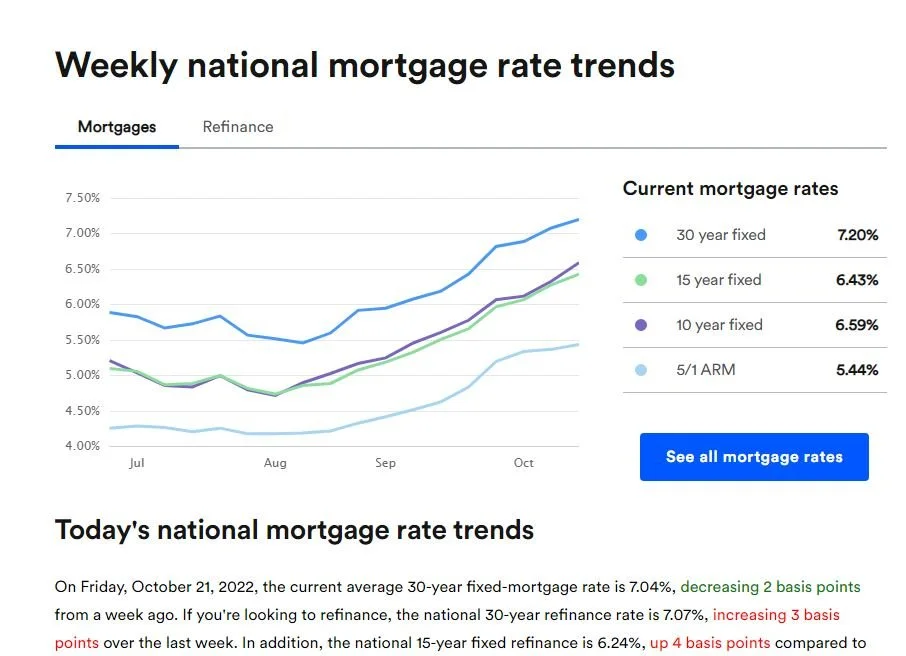
According to the latest article as of this writing dated 10/21/2022, the 30 year fixed rate mortgage remains just shy of 7%. This is having a direct impact that is negatively impacting the housing market.

https://www.cnn.com/2022/10/20/homes/mortgage-rates-october-20

Image taken from bankrate.com

In the past month, I have started to see increasing supply that will soon be balanced and in my opinion, if the current environment remains the same or rates continue to rise, we will see the balance at best or the oversupply at worst we are used to seeing.

What happens when you have decreasing demand and higher supply?

This negatively impacts sales prices. In turn, this causes values to decline.

Unfortunately, this is not good news. It is difficult to know how far this decline will go or how long it will last. According to the CNN article I referred to, home sales have been falling month over month and we are in the longest housing sales slump since October 2007. They also state that applications for home purchases are down 38% and those for refinances have fallen off of a cliff.

This might not be the case for home appraisals and the home sales in our market area, but as is historically accurate in the past, we tend to be on the back end of the national curve. If what they say is true, then we are in the very beginning of this same slump and need to be prepared for the ride.

If you are in the market to purchase a home, refinance or require a home valuation for other purposes such as estates and divorces, you need to be prepared for the value of the property to possibly show a decline from the past 2 years.

What Does An Appraiser Look For?

When either making the appointment or at the property I often hear things like “I’m sorry but I didn’t get a chance to cut my lawn” or “Please excuse the mess as we are packing and have boxes everywhere” or “We are planning on having a deck built later this year and replace the windows after that”.

What ARE we looking for when we are at your property?

You’ve just had an appraiser show up at your door for the appraisal. You now have a stranger in your house that is peering into areas of your home that any other person would need a warrant to see, who will be developing a report that in some instances can have a major impact on your objectives: the purchase of a new home, the ability to take cash out and make needed repairs, refinance to take advantage of rates to get lower monthly payments, etc. Not knowing what they are looking for can leave one feeling pretty anxious.

First, lawn maintenance and tidiness are not on our list. While it is easier to view what we need when the house is neat and tidy, it is not a priority. We are given the liberty to make assumptions that what is not visible is consistent with what is visible. If the carpet and walls appear to be in good condition, then the assumption is made that the carpet under the couch doesn’t have a horrible stain or the wall behind the large mirror does not have extensive damage. Imagine if we had to move everything out of the way so that we see 100% of every surface. A little bit of clutter doesn’t change the way we make assumptions.

To simplify the basic list of what we DO look for when we arrive at your property

size, style, quality and condition.

On the exterior we measure to determine the overall size of the structure(s). This helps us to calculate the gross living area (GLA) and other building areas such as garages, barns, sheds, etc.

Then we are looking at the style, materials and workmanship- ranch vs cape cod, attached garage vs detached garage, brick vs vinyl, metal vs composite shingle, plain design vs ornate and detailed, basic materials vs high end materials, new vs old. Each of these details are documented in order to give us a clear picture of the size, quality and condition.

On the interior, as we walk through the house, we are also determining the same things in addition to the utility or functionality of the property. Overall, how many rooms/bedrooms/bathrooms are there and what is the layout? Is it a 50 year old house with mostly original finishes, has everything been remodeled recently or something in between? Have the short lived items been replaced- hot water tank, furnace, carpeting, etc.? Is it stock grade cabinetry or is it a custom kitchen with all the bells and whistles? Are there 2 bathrooms or 4 bathrooms? All of these details matter.

In all honesty, I don’t even see the dozens of boxes that are packed and waiting for the moving truck to load and bring them to another location. I do notice the newly refinished hardwood flooring, the new furnace, the older plastic tile bathroom (yes we have plastic tile bathrooms in our area- once popular in the 50’s and 60’s), the lack of GFCI outlets near water sources, the settlement cracks in the basement, etc.

For those improvements you are planning to make, unless we are doing an appraisal that is “subject to” these things being completed in the future, what you are planning to do will have no impact on the value. Conversely, the renovations you have made over the years also have little impact in light of what it used to be. We base our analysis on what exists now. It is good for us to know and have a list of those improvements so that our information is accurate. However, if you had carpet when you purchased the property 15 years ago and have since replaced it with hardwood flooring and ceramic tile, what matters is that you currently have the hardwood flooring and ceramic tile.

The next time you are having an appraisal completed on your home, having the regular maintenance of your yard completed and the housekeeping tidy is helpful so that we can see as much of the property in its best light as possible. However, this has little impact on the size, quality and condition of the components that exist the day we are at your property collecting all this data. The existing salient features, their quality and condition are what we are looking for.

Times Are A-Changin'

Over the past couple months, there has been a shift in the market here in the Greensburg area of Westmoreland County. These changes are being affected by multiple factors such as the seasonal time of year that typically impacts real estate, the rise in interest rates and the need for the market to correct itself from the heightened activity over the past year. This shift was so pronounced in a recent appraisal I completed that I had to share it with you. Below is a graph that was taken from a work file for a property I have recently appraised. This is real time data. When you take a look at this graph, it clearly shows that the supply in the market has made a rapid rise within the past month and is starting to equal the Summer of 2020 and pre-Covid levels.

You might ask, “What does this mean?”. Well, I don’t have a crystal ball and am not in the business of being an economic forecaster- so the immediate answer is “I don’t know yet”. Only time will tell. However, just like the leaves are changing color indicating changes are coming, real estate data is starting to tell us that changes are possibly coming in the near future.

Keep updated with my blog. As soon as I have more information to pass along regarding marketing trends, I will pass it along to you.

FHA and Storage Tanks

As most know, FHA follows the guidelines set forth in the HUD Handbook 4000.1 which includes the MPR’s (Minimum Property Requirements) that we have to follow when appraising a property that is being insured by FHA financing. Over time, these requirements are revised and if not fully aware, one might not realize that these changes can affect a property’s ability to qualify for this type of financing.

One of these changes that took place is in regards to storage tanks that contain hazardous or flammable materials- such as propane, automobile fuel, oil, natural gas, etc.

Prior to this change, it used to be that if a property line were within less than 300’ of a property that contained underground storage tanks with a capacity of at least 1,000 gallons of such material, the property did not qualify for FHA insured financing. In some of our towns with corner convenience stores that included gas pumps (such as Greensburg), this meant that any property within 300’ of this did not qualify.

However, HUD has chosen to change the language and now only states that those properties within 300’ of a property with above ground storage tanks do not qualify and has deleted the words “under ground”.

(7) Stationary Storage Tanks

If the subject property line is located within 300 feet of an
aboveground, stationary storage tank with a capacity of 1,000 gallons or more of flammable or explosive material, then the Property is ineligible for FHA insurance, and the Appraiser must notify the Mortgagee of the deficiency of MPR or MPS.

So this is good news. It appears that those properties within 300’ of a gas station that contain underground storage tanks for their fuel now qualify, whereas once they did not.

When Should I Get An Appraisal

Most people know that appraisals need to be completed for lending purposes. But did you know there are a number of other reasons you should be contracting an appraiser to perform a professional valuation on your property?

 1. When you are the seller of a FSBO (For Sale By Owner). My experience in completing appraisals for properties that have been sold without the professional expertise of a real estate professional is that the selling price is often lower than the value. Many people think that they are saving the expense of paying a commission to a broker and therefore have some wiggle room in deciding on a sale price. Based on my research of keeping the data on these types of transactions, at least 75% - 80% of the time, the seller would have had a higher net income even if they were to have paid the commission. If you plan on selling your home, you have two options- either contract a real estate agent to properly help you price and market the home or get an appraisal so that you can maximize your income from the sale.

 2. When you are a cash buyer you definitely want to get an appraisal. In cases where a buyer is using financing, there is a built in fail safe because the lender is going to require an appraisal. If the appraisal determines that the value of the property is less than the agreed upon purchase price, this will impact the loan and often allow the parties to renegotiate in order to make the transaction work. If you are paying cash, you should choose an appraisal contingency that allows you the option to have an appraisal completed. This way you can be assured that what you are choosing to pay is based on the information about what the property is worth. In todays crazy market, many people are choosing to pay more just to get into a house, but with an appraisal it would be a willing choice based on being informed. If you would prefer to not pay more than the property is worth, then an appraisal contingency will allow you to either renegotiate or back out without penalty.

 3. When you are the executor or executrix for an estate. Estate appraisals are necessary to be able to pay the appropriate level of estate taxes. Many times the probate attorney will need an appraisal in order to properly calculate the estate taxes. This information can also be helpful in determining if a family member is willing and able to purchase the property or if it is best to sell it on the open market.

4. Divorce litigation- Divorces are never easy and when there is shared real estate involved, typically an appraisal will be ordered by both parties as part of the overall process. These appraisals should not be considerably different as it should not matter which side the valuation is being performed for. In some cases, if there is a significant difference in the values, the court will order a third or make a ruling based on the testimony of the appraisers for the reports already completed. This value becomes important if you have ever heard the term “buy out”. The party that desires to stay in the home has to buy out the party that is no longer going to be in the home.

 5. Consulting services are what you need if you are looking to remodel, subdivide or construct an new addition. If you are looking to make major renovations, subdivide a large parcel of property into smaller multiple parcels or construct an addition to your home, it is strongly advised to consult a real estate appraiser to help you in determining how to maximize the value versus the cost. Too often I’ve encountered many well intended owners who spend tens of thousands of dollars to make major renovations to their home or property without realizing that the return on their investment is minimal and no where near the investment they made. In the end, they are saddled with a large amount of debt and little return to show for it. A few firsthand examples I have seen is the $75,000 spent for a custom in ground pool, the $3,000,000+ custom home in an area that has median sale prices around $200,000 or the $100,000 renovation to a 150 year old barn with minimal contributory value. Consulting services can help you determine the best renovations to make resulting in the highest market value or it can help give you an insight into the highest potential for a subdivision or addition.

 There are other possible reasons for needing an appraisals, such as tax appeals, bankruptcy or eminent domain, but these are some of the more common ones. In the near future, I’d like to expound on these in even more detail. In the meantime, if you need an appraisal for any purpose, please trust the Gold Level Real Estate Appraisal Office from the Best of Westmoreland County 2022 contest. We would be more than happy to help you with all of your real estate valuation needs.

Another Electric Recall

Did you see the latest electrical recall headline? Schneider Electric™ Recalls 1.4 Million Electrical Panels Due to Thermal Burn and Fire Hazards

That is a lot of electrical panels. The long standing recall for unsafe panels dealt with Federal Pacific Stab-lok Breakers. Now the new recall involves “Square D” breakers and panels manufactured by Schneider Electric.

The hazard is described as: The load center can overheat, posing thermal burn and fire hazards. Specifically:

The issue detected is a loose neutral screw connection within the QO Plug-On Neutral Load Center.

The recall affects Square D QO Plug-on neutral load centers, commonly called breaker boxes or electrical panels, that might have been installed in homes, recreational vehicles, or commercial structures such as restaurants, manufacturing facilities, warehouses, commercial lighting, and others.

The affected products were manufactured between February 2020 and January 2022, with date codes between 200561 and 220233. Circuit breaker boxes and covers manufactured between December 2019 and March 2022 are also included in the recall.

The recall notice provides advice on how to read the date codes:

For installed outdoor load centers, the manufacturing date codes are printed on the inside of the cover or door of the unit or on the box itself when the cover or door is open.

For installed indoor load centers, a qualified electrician can locate the interior date codes that are not visible to the home owner.

If you think you have one of these panels installed in your home, call a certified electrician to not only determine if you have one of these panels, but can replace any needed faulty components with ones that do not pose a hazard to your home.

For more information click on the link below:

https://www.cpsc.gov/Recalls/2022/Schneider-ElectricTM-Recalls-1-4-Million-Electrical-Panels-Due-to-Thermal-Burn-and-Fire-Hazards